Nokia Lumia 720 is a mid-range bonanza
LG launches worlds slimmest full-HD LCD panel for smartphones
Nigeria's endless cycle of corruption
Egypt: Elections do not make a democracy
S. Korean plane crashes in San Francisco
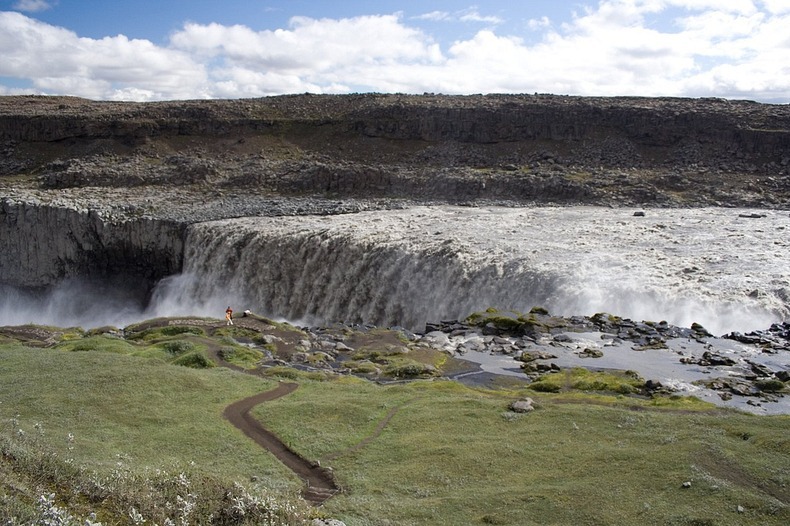
Dettifoss - The Most Powerful Waterfall in Europe
The waterfall Dettifoss is located in Vatnajökull National Park in Northeast Iceland, and reputed to be the most powerful waterfall in Europe. It is also the largest waterfall in Europe in terms of volume discharge, having an average water flow of 193 cubic meter per second. Its volume often increases, especially when the weather or volcanic activity prompts glacial melting on the Vatnajokull glacier icecap. The waterfall is so powerful that it makes the surrounding rocks vibrate, the vibrations can be felt by hand.
Dettifoss is situated on the Jökulsá á Fjöllum river, which flows from the Vatnajökull glacier and collects water from a large area in Northeast Iceland. The fall is 100 metres wide and have a drop of 45 metres down to the Jökulsárgljúfur canyon.

Windows 8.1 preview available for download
On Wednesday, Microsoft made a preview version of Windows 8.1 available for download. It includes alterations meant to address consumer dissatisfaction with the operating system. Analysts believe users' frustration with Windows 8 is partly to blame for the biggest drop in personal computer sales in nearly two decades.
At a conference in San Francisco, Microsoft CEO Steve Ballmer acknowledged that the company pushed hard to get people to adopt a radical new tile-based "Modern" user interface in Windows 8. Microsoft is now back-pedaling, making it easier to reach and use the older "Desktop" interface.
"Let's make it easier to start applications the way we're used to," Ballmer told the audience of software developers. "What we will show you today is a refined blend of our Desktop experience and our Modern experience."
Windows 8, released Oct. 26, was Microsoft's answer to changing customer behavior and the rise of tablet computers. The operating system emphasizes touch controls over the mouse and the keyboard, which had been the main way people have interacted with their personal computers since the 1980s.
Microsoft and PC makers had been looking to Windows 8 to revive sales of personal computers, but some people have been put off by the radical makeover. Research firm IDC said the operating system actually slowed down the market. Although Microsoft says it has sold more than 100 million Windows 8 licenses so far, IDC said worldwide shipments of personal computers fell 14 percent in the first three months of this year, the worst since tracking began in 1994.
Windows 8 was also supposed to make Microsoft more competitive in the growing market for tablet computers. But Windows tablets had less than a 4 percent market share in the first quarter, compared with 57 percent for Android and 40 percent for Apple's iPad.
Among the changes present in Windows 8.1, users will be able to boot up in Desktop mode. There, they'll find a button that resembles the old Start button. It won't take users to the old Start menu, but to the new Modern Windows 8 start screen. Still, the re-introduction of the familiar button may make it easier for longtime Windows users to get accustomed to the changes. A common complaint about Windows 8 is that it hides features and functions, and replaces buttons with gestures and invisible click zones that have to be memorized. Now, a single swipe up from the Modern start screen brings up all programs, even those that are seldom used.
Other new features of Windows 8.1 include more options to use multiple apps. People will be able to determine how much of the screen each app takes while showing up to four different programs, rather than just two. The update will also offer more integrated search results, showing users previews of websites, apps and documents that are on the device, all at once.
Microsoft also touted a broadening array of applications specifically written for Windows 8, among them one from Facebook.
Frank Gillett, an analyst with research firm Forrester, said that with 8.1, Microsoft is doing a better job of uniting the Desktop and Modern screens, but the changes don't run deep.
"They smoothed off some rough edges, but they don't fundamentally change the experience of having two experiences within one operating system," he said.
One big problem is the fact that Windows 8 doesn't work well on smaller screens, making Windows tablets less competitive with cheaper tablets such as Apple's iPad Mini, Google's Nexus 7 and Amazon's Kindle Fire HD.
It's crucial that Microsoft sets things right with Windows 8.1 because the outlook for the PC market keeps getting gloomier. IDC now expects PC shipments to fall by nearly 8 percent this year, worse than its previous forecast of a 1 percent dip. IDC also anticipates tablets will outsell laptop computers for the first time this year.
Microsoft is addressing that shift by banking its future on touch controls - but it also unveiled new functions for giving computers voice commands and using a device's camera to recognize simple gestures such as swipes in mid-air. Its strategy calls for having just one operating system work on both tablets and traditional computers. That allows popular Windows programs such as Office to work well on tablets, too. But in emphasizing these new interfaces, mouse and keyboard commands are more complex to use and figure out.
Apple and Google, on the other hand, believe people use those machines differently and have opted to keep their operating systems separate. Apple, for instance, believes that it can be tiresome to have to constantly move your arm to touch a desktop or laptop screen. That's not a problem with tablets because you're already holding it.
Microsoft also said very little about Windows RT, the Windows 8 variant that's designed to run on the same phone-style processors that let the iPad and Android tablets be lighter and have longer battery lives than Windows 8 tablets with PC-style Intel processors. Windows RT has been hamstrung by a lack of applications, since it won't run older Windows programs. But Ballmer said there will be 100,000 apps that run on all newer versions of Windows by the end of the month. And a new line of Intel processors code-named "Haswell" are expected to greatly improve battery life without sacrificing processing power on mobile devices.
Microsoft Corp. just cut the effective price of its Surface tablet with Windows RT by including a keyboard cover for free. The cover sells for $120 or $130 on its own.
Microsoft also said this month that it would give buyers of the RT version of Surface the Outlook email and calendar program at no extra charge - joining other Office freebies Excel, Word and Power Point - and sweetening the offer for the device that is priced starting at $499. The new programs will come as part of the Windows 8.1 update.
Nelson Mandela Passed Away!!!!
Nelson Mandela is dying.
Hard as it to accept the fact, the world has to come to terms with it.
It's not surprising that South Africans are praying for his recovery. But perhaps a final gesture of gratitude to the man who is indisputably the Father of the Nation is to pray for his peaceful death. Or passing. Or transition. If those euphemisms offer some solace and sound less final than death.
Nelson Mandela is almost 95. He has been in and out of hospital three times this year. Newsrooms around the world have probably gotten his obituary ready more than once. His health has gone up and down, each "recovery" a little slower than the previous one.The man's body is tired. Reports say he has not opened his eyes in days and is largely unresponsive.
But as a society, we now have the medical capability to prolong life to a degree our grandparents could never imagine. Every day in hospitals all over, elderly patients, entirely non-functional, unable to register anything, are hooked up to ventilators offering some semblance of life and hope to the family around them. And it's a lucrative source of revenue for hospitals which always seem very eager to strap on the ventilator and charge a hefty fee. A doctor friend once told me that the ventilator was meant as a temporary breathing assistance for a young person who might have had some traumatic injury or illness but who hopefully would fully bounce back to life afterwards. It was never meant to be a semi-permanent breathing solution for a person already dying.
I am not implying at all the hospital in Pretoria has ulterior motives in prolonging Mandela's life. It's just that determining what is the natural end of a life has become increasingly more complicated and fraught for all of us.
All my grandparents died at home. It does not mean the deaths were easy and peaceful. One grandfather died in his sleep, one from a stroke in his sixties. My grandmothers both died after painful struggles with cancer. My great grandfather lived hale and hearty till 95, had a stroke, and as he lay in bed, unable to speak, kept pointing to a curtain. It was askew and obviously deeply bothered him. He was a particular man. It was fixed to his satisfaction. The next day he died peacefully with minimum fuss.Now the advancement of medical technology has meant a longer life, as well as the hope of recovery from illnesses that felled our grandparents. But it has also meant we can cling on to life with greater tenaciousness and artificiality. Visiting a great-aunt at a hospital not so long ago, I tried to reconcile the jolly beaming woman I knew with the shapeless lump under a hospital sheet, tethered to tubes and a ventilator, reduced to a line on a monitor, silent except for the shuddering intake of breath. Once she looked at me, and her eyes were so full of pain and questions, I had to drop my gaze.
It is hard to let loved ones go. Sometimes it's because the children scattered around the world need to come. But mostly it's because we keep hoping for miracles, that she will get better. At 95 Nelson Mandela, even if he comes out of hospital one more time, is not likely to get better. But we still hope. "Nelson Mandela, for me, is like my father," Alex Siake, a South African,said in Pretoria. "Every day, I just pray that he can recover quickly and be among us again."
However even as we cling to life, no one wants to cling to suffering. The other day I remember worrying about how upset my mother would be about the death of a close friend. But to my surprise, she was almost envious that her friend had died after a stroke in the bathroom without any apparent suffering. The vision of an old age with a broken hip, spiraling diabetes, or a new cancerous tumour, stuck full of needles in an ICU is an ever present terrifying nightmare as we grow older.
But for those around the patient, it's hard to let go because it feels wrong to pull the plug on a loved one. We are not used to, or comfortable, playing God in that fashion. We are plagued by hope against hope. Often the people closest to the dying, the ones likely to be most affected, are the ones who come to terms with letting go. It's the son who lives abroad, rushing in at the last moment, who desperately wants to prolong life by throwing every medical advancement at a tired and battered weary body.
Mandela's daughter Makiziwe is quoted as saying she is praying his "transition is smooth". But Daliwe Bida, a resident of Mandela's native village told the media, ""We are praying non-stop because we don't know what can happen if he leaves us." One can understand the stakes are that much higher when it's a person of the stature of Nelson Mandela. The pressure to keep the man alive almost reaches the point of wanting to keep him immortal.
South Africans have been asked to pray for his recovery as if praying for his death would appear ungrateful. As long as he is physically alive he gives a certain reassurance to his nation, and even to the world. Unlike many other statesmen, his stature has not faded around the world even though he has long left office because his stature was never really tied to his office. It preceded him becoming the President of South Africa and lived on after he relinquished that post. In fact, it grew even more powerful that the man who could easily have been South Africa's president for life, in a continent where many freedom-fighting founding fathers chose to do just that, decided to retire.
Yet in his long goodbye, Nelson Mandela is also teaching us something. That no matter how much we want to hold on to something or someone, sometimes we have to let them go. Nelson Mandela has given a lot the world. To let go of Nelson Mandela is perhaps the greatest gift of gratitude the world can offer him at this point.
Flooding in western Canada
A search and rescue boat carries rescued passengers from a flooded industrial site near highway 543 north of High River, Alberta, Canada on Friday, June 21, 2013. The rescued passengers spent the night moored on a structure they built in the water. Calgary's mayor said Friday the flooding situation in his city is as under control as it can be, for now. Officials estimated 75,000 people have been displaced in the western Canadian city. Mayor Naheed Nenshi said the Elbow River, one of two rivers that flow through the southern Alberta city, has peaked.
Ancient Egyptian Statue starts SPINNING on its own
THE curse of Tutankhamen is said to have claimed more than 20 lives. By contrast, the curse of Neb-Senu amounts to little more than an occasional inconvenience for museum curators. Over several days, the ten-inch Egyptian statuette gradually rotates to face the rear of the locked glass cabinet in which it is displayed, and has to be turned around again by hand. Those who like tales of haunted pyramids and walking mummies may regard the mystery of the 4,000-year-old relic – an offering to Osiris, god of the dead – as the strangest thing to hit Egyptology in decades.
Egyptologist Campbell Price studies an ancient Egyptian statuette
at the Manchester Museum, which appears to be moving on its own.
The 10-inch tall relic, which dates back to 1800 BC, has been at the
museum for 80 years but curators say it has recently starting rotating
180 degrees during the day.
Experts decided to monitor the room on time-lapse video and were
astonished to see it clearly show the statuette spinning 180 degrees -
with nobody going near it.
In this time lapsed video, as the museum closes for the evening,
the statue can be seen in a clearly different position.
The following morning the statue has moved again, and is facing
even further away from its original position.
By the end of the day the statue has turned almost 180 degrees and
is now facing away from visitors to the museum.